
The Limits of Detection
The A.B.C. MurdersThis thread traces the novel’s inquiry into what evidence can establish, and why a case is not solved until its person and motive are understood.
increasing Bearing strength in each event
 decreasing
Bearing strength in each eventdecreasingEvidence Without Understanding

A Clue Is Not a Solution
Visible facts
The body, witnesses, and railway guide establish that a crime has occurred. None identifies the killer’s purpose with certainty.
Competing explanations
Franz Ascher seems plausible, while the letter suggests an outsider. Poirot recognizes that the same evidence can support different stories.
A Pattern Without a Motive
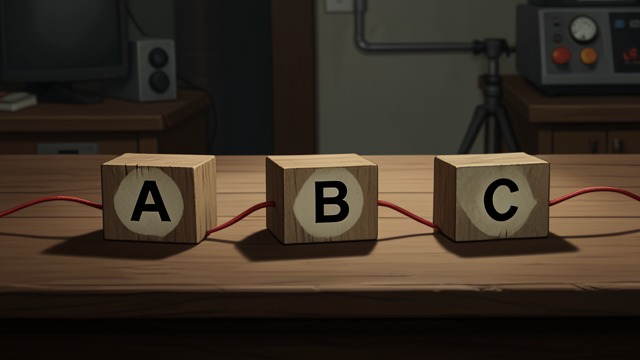
The Limits of Classification
The alphabet explains sequence
A, B, and C offer a convenient account of where the crimes occur. The pattern organizes observations but does not explain why the victims die.
The question persists
Poirot refuses to treat a classification as a motive. The distinction keeps the investigation open after others think the explanation is obvious.
A Convincing False Case

Proof Points to Cust
Material certainty
The stockings, guides, typewriter, and bloody knife appear to form a complete chain against Cust. Police can construct a persuasive prosecution.
Personal inconsistency
Cust’s timid nature and his genuine confusion do not fit the daring author of the crimes. The evidence is strong but has been deliberately arranged.
The Alibi’s Importance

One Crime Does Not Fit
Eastbourne evidence
A witness places Cust at Eastbourne during Betty’s murder, creating a serious gap in the prosecution’s story. Poirot refuses to dismiss it as a technicality.
A hidden division
The alibi suggests that the apparent series may contain more than one actor. The contradiction opens the possibility that Cust is a decoy rather than the killer.
The Case Is the Man

Understanding Completes Detection
Identity and motive join
Poirot identifies Franklin Clarke by combining financial interest, access, character, and the design of the letters. No single clue would have been enough.
A deeper standard
The case is solved only when the apparent contradictions in Cust and Clarke are explained. Detection requires understanding who acted and why.
After the Andover murder
After the Churston murder
After Cust’s arrest
During Poirot’s review of the case
At Poirot’s final explanation
